What are the Best Crypto Compliance Providers in 2026?

Crypto compliance provider used to mean one thing: screen wallets, trace funds, flag risky transactions. That definition no longer fits the way on-chain finance is being built in 2026. As institutions move real volume on-chain, stablecoins become settlement rails, and privacy-with-compliance turns into its own product category, a single stablecoin issuer, payment company, wallet, RWA platform or DeFi application now needs several compliance layers at once. One layer scores wallet risk. Another enforces transaction rules before execution. Another handles Travel Rule workflows. And for private transaction systems, a governed way to review confidential evidence without exposing unrelated user activity.
That is why buyers keep comparing tools that do different jobs. Chainalysis, Elliptic, TRM Labs, Merkle Science, Crystal, Scorechain, Range, Predicate, Blockaid, Notabene, Solidus Labs, Sardine and Arcane all sit inside crypto compliance conversations, but their strongest use cases differ. This guide maps the market by layer, shows where each provider fits, and gives a plain decision guide at the end.
The four layers of on-chain compliance
On-chain compliance in 2026 splits into four layers. Each sells a different job.
Layer | What it sells | Provider |
|---|---|---|
Analytics / KYT | Risk intelligence on addresses, entities and transaction flows | Chainalysis, Elliptic, TRM Labs, Merkle Science, Crystal, Scorechain, Range |
Policy enforcement | Programmable rules that approve or deny a transaction before execution | Predicate, Blockaid |
Regulatory workflow | Travel Rule, counterparty compliance, market surveillance, fraud | Notabene, Solidus Labs, Sardine |
Governed disclosure | Controlled review of confidential transaction evidence: cases, scopes, access windows, audit trail | Arcane |
Analytics and KYT providers sell risk intelligence on addresses, entities and transaction flows. This category is used for:
Wallet screening
Transaction monitoring
Tracing
Investigations
Compliance operations
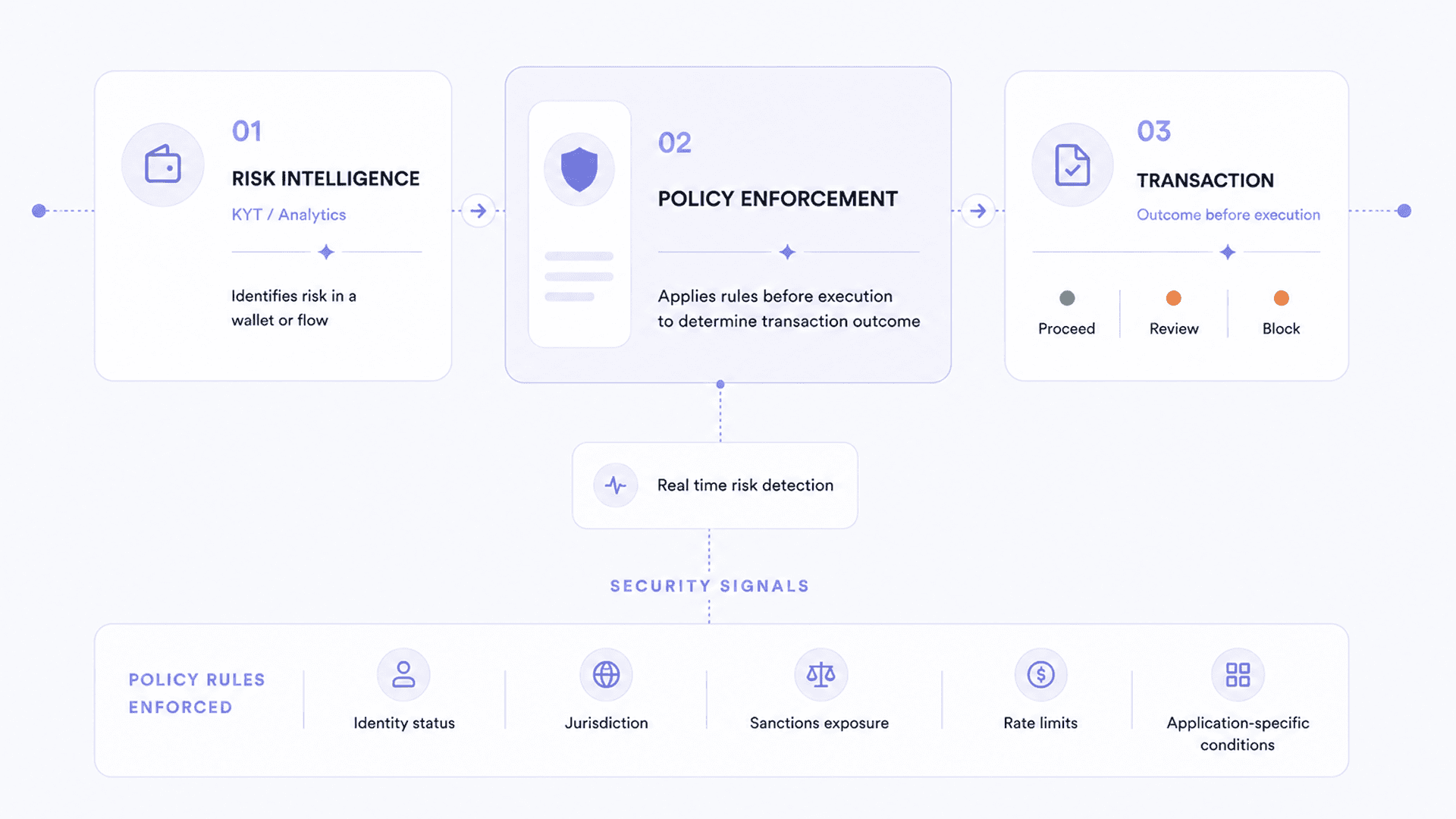
Policy enforcement providers help teams apply transaction rules before execution. These are checks on who can use an application, which assets are allowed, and under what conditions, enforced in real time as the transaction runs.
Regulatory workflow providers handle compliance processes around:
Travel Rule
Counterparty checks
Market surveillance
Fraud
Account-level risk
Governed disclosure for private systems is a separate layer, and it is the newest one. This is where Arcane fits. It gives teams building private on-chain finance a controlled way to review confidential transaction evidence by case, role, scope and time window, with an activity trail for audit and reporting. Instead of holding one key that opens everything, an authorized reviewer sees only specific evidence. That mechanism is known as selective disclosure.
Blockchain compliance platform comparison
The table below summarizes how the providers compare on layer, primary use, and where each is strongest.
Provider | Layer | Primary use | Strongest for |
|---|---|---|---|
Arcane | Governed disclosure | Case-based review of confidential transaction evidence | Private payments, treasury, payroll, stablecoin settlement and RWA systems that must stay confidential yet reviewable |
Chainalysis | Analytics / KYT | Screening, tracing, investigations | Largest deployed base, investigations and evidentiary quality |
Elliptic | Analytics / KYT | Screening, monitoring, investigations | Broad asset coverage and compliance operations |
TRM Labs | Analytics / KYT | Cross-chain screening and threat intelligence | Cross-chain risk detection and crypto-crime investigations |
Merkle Science | Analytics / KYT | Behavior-based risk detection | Predictive, behavior-based detection beyond list-based screening |
Crystal | Analytics / KYT | Analytics and investigation tooling | Transaction tracing |
Scorechain | Analytics / KYT | AML tooling, risk scoring | Transaction monitoring and risk scoring |
Range | Analytics / KYT | On-chain risk and monitoring | Real-time on-chain risk signals for compliance flows |
Predicate | Policy enforcement | Programmable pre-transaction policy | AML/CFT checks, identity, geofencing, rate limits enforced on-chain |
Blockaid | Policy enforcement | Real-time risk exposure, security-led | Security and real-time transaction risk |
Notabene | Regulatory workflow | Travel Rule, counterparty compliance | Travel Rule and stablecoin payment authorization |
Solidus Labs | Regulatory workflow | Trade surveillanc, market integrity | Market surveillance and manipulation detection |
Solidus Labs | Regulatory workflow | Fraud, onboarding,account risk | Fraud and account-level risk |
Governed disclosure for private transaction systems
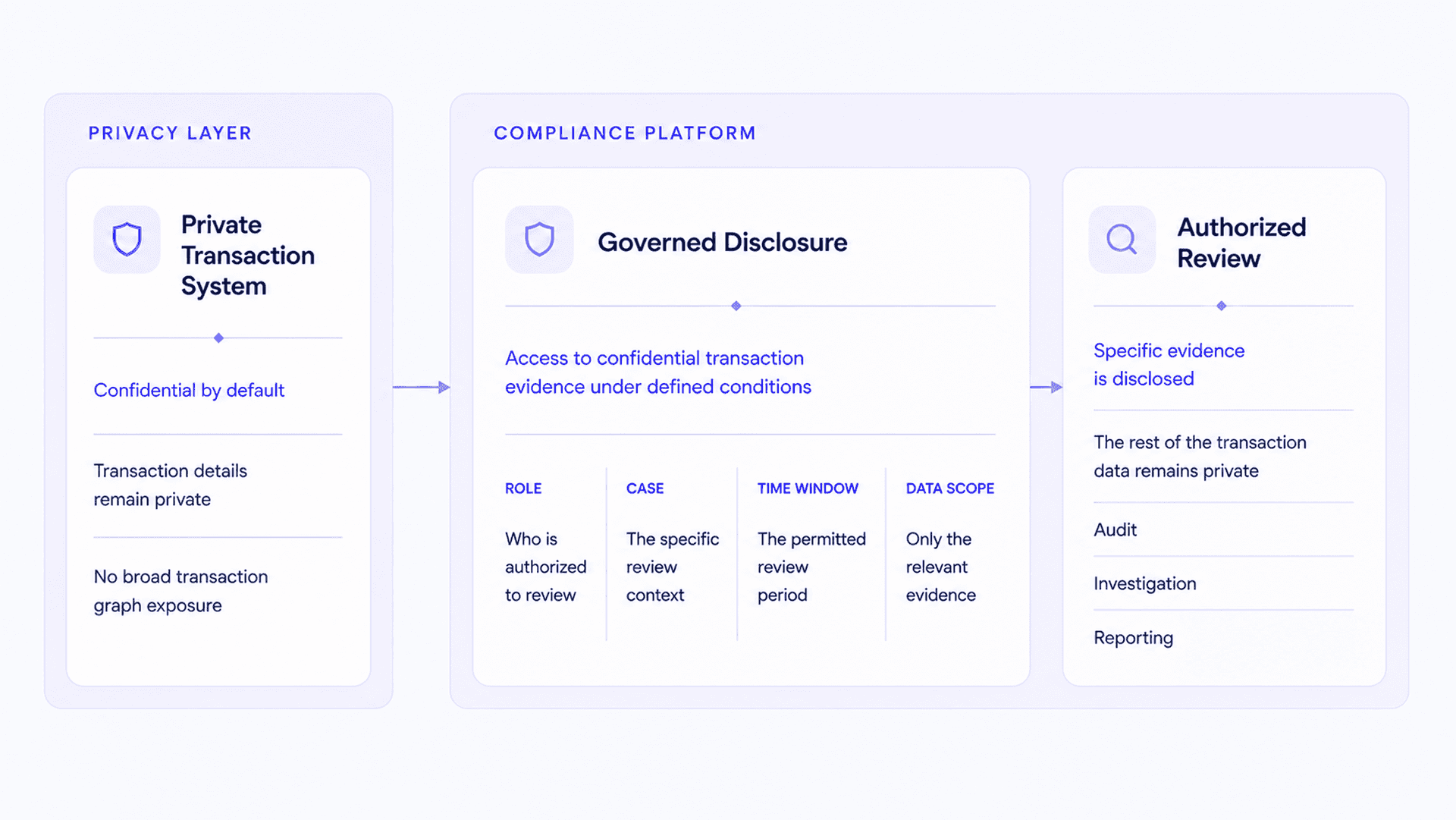
Arcane is compliance-ready privacy infrastructure for private on-chain financial flows. Its product stack combines а Privacy Layer with a Compliance Platform, so applications can support confidential transfers while preserving a defined review path for audits, investigations and reporting.
The core idea is governed disclosure. A private system keeps transaction details confidential by default, while still giving authorized parties a way to review specific evidence under defined conditions. That review can be bound by role, case, time window and data scope. The goal is controlled access to relevant evidence, not broad exposure of a full transaction graph. The mechanism that makes it precise is selective disclosure: a reviewer is shown only specific fields, for a specific operation, asset or period, while everything else stays private.
This category matters for:
Confidential payments
Private treasury flows
Payroll
Stablecoin settlement
RWA transfers
Institutional transaction systems
These use cases need privacy for normal operations, and they also need a way to support compliance review when a legitimate case exists.
Arcane does not sell risk intelligence in the same category as Chainalysis, Elliptic, TRM Labs or Merkle Science. It integrates with the risk-intelligence layer. That boundary matters. KYT providers help identify risk before and during transaction flows. Arcane governs access to confidential transaction evidence when a private system needs review, reporting or auditability.
For a payment company using confidential transfers, Arcane's role is the controlled review path. The company can screen funds through a KYT provider, apply pre-transaction rules through a policy layer, and use Arcane to manage encrypted records, access controls, disclosure requests and audit trails. For the exact workflow, including how a request is scoped, approved and recorded, see how the Compliance Platform works.
More from the Arcane blog:
Why Compliant Privacy Is a Business Requirement for Fintech Companies on Stellar
Launch a Compliant Confidential Token with Arcane's SDP Extension
Analytics and KYT providers
Chainalysis is one of the best-known blockchain analytics and KYT providers. Its products are used for crypto compliance programs, investigations and risk monitoring across crypto businesses, financial institutions and public-sector teams, with a focus on monitoring illicit exposure and transaction risk.
Elliptic is one of the longest-running blockchain analytics providers, with broad digital-asset coverage. Its materials focus on blockchain analytics, wallet and transaction screening, investigations and digital-asset risk intelligence. For buyers comparing KYT providers, Elliptic is often shortlisted when broad asset coverage and compliance operations are central requirements. Elliptic is a live Arcane integration.
TRM Labs focuses on blockchain intelligence, transaction monitoring, investigations and threat intelligence. Its positioning centers on cross-chain risk detection and crypto-crime investigations for financial institutions, crypto businesses and public-sector agencies. TRM Labs is a named Arcane partner.
Merkle Science focuses on crypto risk and compliance, with monitoring and investigation tools used by exchanges, fintechs, law enforcement and financial institutions. Its positioning centers on behavior-based risk detection in addition to address- and list-based screening. Merkle Science is a named Arcane partner.
Crystal and Scorechain both sit in the analytics and KYT category. Crystal provides blockchain analytics and investigation tools for tracing crypto transactions. Scorechain provides AML compliance tooling for crypto businesses and financial institutions, including transaction monitoring and risk scoring.
Range provides on-chain risk and monitoring for compliance teams and appears in buyer conversations around on-chain compliance. It surfaces real-time risk signals on addresses and flows that a compliance program can act on. Range is a live Arcane integration, used on the screening side of Arcane's compliance model.
These providers overlap in practice. A compliance team may use one for wallet screening, another for investigations, and a third for a second opinion on higher-risk flows. The buyer question is the use case, whether screening, monitoring, tracing or investigations, not which vendor is "best" in the abstract. The category job is consistent: analytics vendors provide risk intelligence on addresses, entities and transaction activity.
Policy enforcement providers
Predicate sits in the policy enforcement layer. Its product is programmable policy for blockchain applications, meaning rules for who can use applications and assets, enforced in real time on transactions. Typical policy use cases cover AML, identity verification and compliant on-chain transactions.
This layer is useful when a team wants rules to run before a transaction completes. A stablecoin issuer, RWA platform or DeFi application may need checks around:
Identity status
Jurisdiction
Sanctions exposure
Rate limits
Application-specific conditions
Predicate's category is the enforcement of those rules in the transaction path.
Blockaid approaches the market from a security-led angle, with products focused on real-time risk detection for wallets, dApps and on-chain transactions. Its partnership with Predicate connects real-time risk exposure to on-chain policy enforcement, so security risk and compliance policy can meet before execution.
Policy enforcement does a different job from analytics. A KYT provider may identify risk in a wallet or flow. A policy layer applies rules that decide whether a transaction can proceed, needs review or should be blocked.
Regulatory workflow providers
Notabene is strongest where Travel Rule and counterparty compliance are the main requirement. Its Travel Rule product supports workflows for virtual asset service providers, and it has introduced a compliance platform for stablecoin payments focused on Travel Rule, payment authorization and crypto AML workflows. That makes Notabene relevant for exchanges, stablecoin payment firms, wallets and financial institutions that need to exchange required originator and beneficiary information with counterparties. It is a regulatory workflow layer rather than a general privacy layer. Notabene is a named Arcane partner.
Solidus Labs fits the market surveillance and market integrity category. Its products focus on crypto-native trade surveillance, transaction monitoring and market abuse detection. For exchanges, brokerages and marketplaces, this category matters when trading activity itself needs review for manipulation, abuse or suspicious patterns.
Sardine focuses on fraud and account-level risk. Its products are used in fintech and crypto onboarding, payments and fraud prevention. A company looking at signup abuse, account takeover, payment fraud or fiat-to-crypto risk may place Sardine in the compliance and risk stack alongside KYT and monitoring tools.
These vendors handle workflows around rules, records, counterparties, behavior and reporting. They may overlap with analytics providers in some areas, especially transaction monitoring and suspicious-activity review. The buyer question is the use case: Travel Rule, market surveillance and fraud controls call for different systems.
How the compliance layers work together
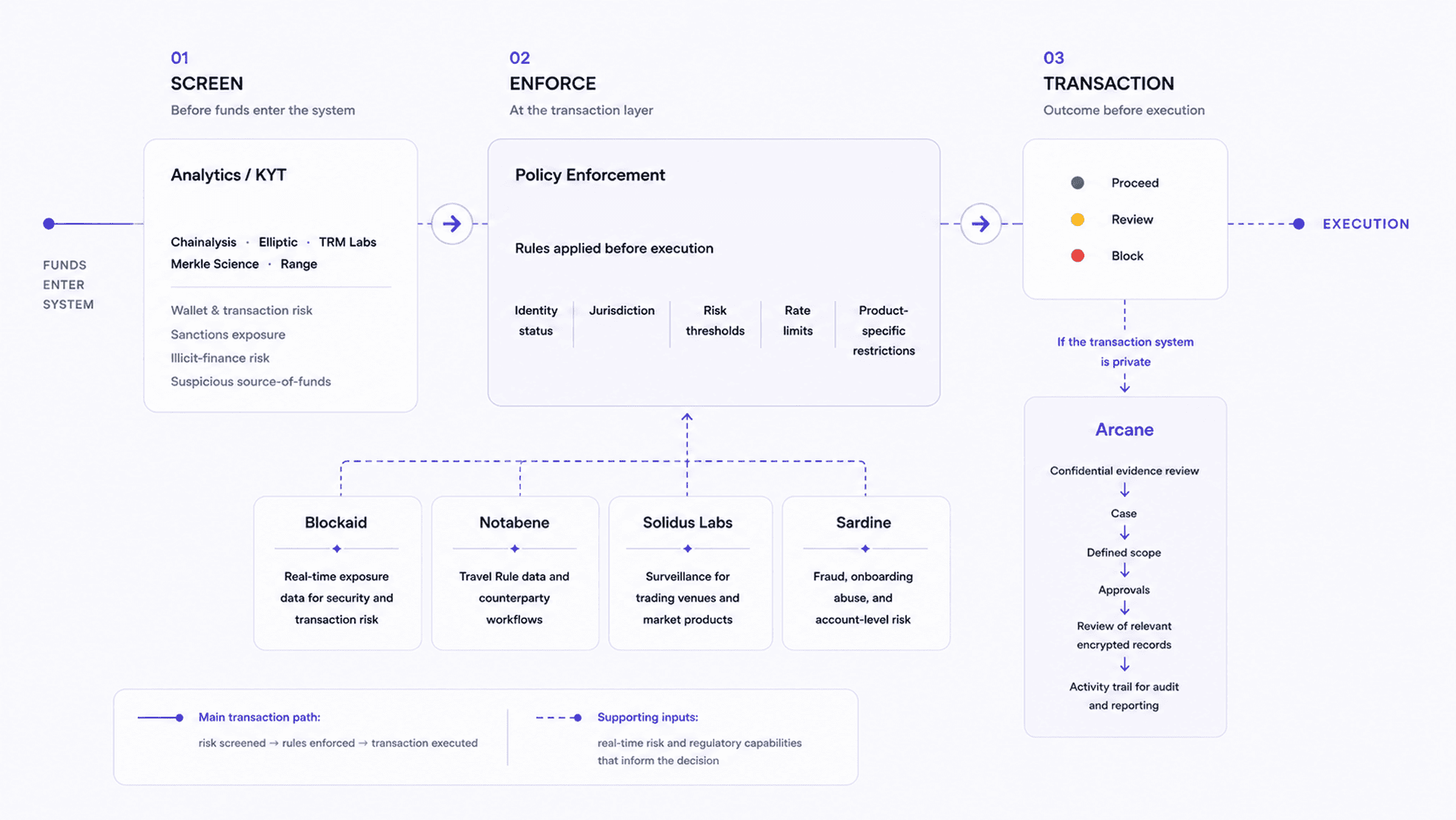
A payments company running confidential stablecoin transfers gives the cleanest example of how the layers combine.
Before funds enter the system, the company screens wallets and transaction history with a KYT provider such as Chainalysis, Elliptic, TRM Labs, Merkle Science or Range. This helps assess sanctions exposure, illicit-finance risk and suspicious source-of-funds signals.
At the transaction layer, a policy provider such as Predicate applies rules before execution. Those rules may cover:
Identity status
Jurisdiction
Risk thresholds
Rate limits
Product-specific restrictions
Blockaid can add real-time exposure data where security and transaction risk are part of the decision. If Travel Rule data or counterparty workflows are required, Notabene can handle that regulatory process. If the company operates a trading venue or market product, Solidus Labs may cover surveillance. If the main problem is fraud or onboarding abuse, Sardine may cover account-level risk.
Arcane fits when the transaction system itself is private. It gives the company a governed path to review confidential transaction evidence without making every user's financial activity public. A compliance officer can work through:
A case
A defined scope requested for that case
The required approvals
Review of only the relevant encrypted records, with an activity trail that supports later audit and reporting
That stack is not a contradiction. It is how on-chain compliance is becoming modular in 2026, with four cooperating layers rather than one tool:
Risk intelligence
Policy enforcement
Regulatory workflows
Governed disclosure
How to choose a crypto compliance provider
Match the provider to the job:
Need wallet screening, transaction monitoring, tracing or investigations? → Analytics / KYT providers: Chainalysis, Elliptic, TRM Labs, Merkle Science, Crystal, Scorechain or Range.
Need programmable transaction rules before execution? → Policy enforcement: Predicate, Blockaid.
Need Travel Rule and counterparty compliance? → Notabene.
Need trade surveillance and market integrity? → Solidus Labs.
Need fraud prevention or account-level monitoring? → Sardine.
Need a governed way to review confidential transaction evidence from private flows? → Arcane.
The right blockchain compliance platform depends on the job. A mature on-chain finance stack in 2026 may use several providers at once, with each one covering a defined layer.
FAQ
What is a crypto compliance provider?
A crypto compliance provider gives businesses the tools to meet regulatory and risk requirements for on-chain activity. In 2026 the term spans four different jobs: risk intelligence on wallets and flows (KYT/analytics), programmable rules enforced before a transaction executes (policy enforcement), regulatory processes such as Travel Rule and market surveillance (regulatory workflow), and controlled review of confidential transaction evidence in private systems (governed disclosure).
What is the difference between KYT and Travel Rule compliance?
KYT (Know Your Transaction) is about screening and monitoring wallets and transaction flows for risk such as sanctions exposure, illicit-finance signals and suspicious activity. Travel Rule compliance is about exchanging required originator and beneficiary information between the institutions on either side of a transfer. KYT assesses the transaction. Travel Rule handles the counterparty information workflow around it. Many firms need both.
Do I need more than one compliance provider?
Often, yes. The layers do different jobs and generally do not replace each other. A payments company running confidential stablecoin transfers might use a KYT provider for screening, a policy layer for pre-transaction rules, a Travel Rule tool for counterparty data, and a governed-disclosure layer for reviewing private evidence. A mature stack usually combines several providers, each covering one layer.
What is selective disclosure in a private transaction system?
Selective disclosure lets an authorized reviewer see only specific transaction evidence, meaning defined fields for a defined case, instead of a full transaction history. In Arcane this sits inside a broader governed-disclosure model, where every review is bound by purpose, role, scope and time window, with an activity trail for audit.
How do I choose a crypto compliance provider?
Start from the job, not the brand. If you need wallet screening and investigations, look at analytics/KYT vendors. If you need programmable rules before execution, look at policy enforcement. If you need Travel Rule, look at Notabene. If you need trade surveillance, look at Solidus Labs. If you need fraud controls, look at Sardine. If you need a governed way to review confidential evidence from private flows, look at Arcane.
Further reading and sources
Arcane
Provider primary sources
Industry analyses and news
TRM Labs, "What is the Best Blockchain Intelligence Tool in 2026?"
Allium, "Blockchain Intelligence Platforms 2026: Compliance and Public Sector Teams"
CoinDesk, "Crypto AML Firm Notabene Introduces Compliance Platform for Stablecoin Payments"