Compliance-Ready Privacy on Stellar

Compliance-Ready Privacy on Stellar
Stellar has become a fundamental network for payments, stablecoins, and financial applications. That raises a sharper question: what does the next layer of infrastructure need to look like if real-world payments are going to move on-chain at scale?
For Arcane Finance, the answer is clear. Payments need privacy and compliance in the same system, and Stellar is one of the strongest places to build it.
Stellar Provides The Payment Foundation
The case for Stellar starts with what the network already does well. Stellar is an established open-source, permissionless blockchain focused on moving money and supporting financial access, with a marathon level track record in real-world financial applications. That focus shows up through stablecoin growth, payment partnerships, and enterprise activity across the ecosystem.
The recent flow of announcements gives it a bigger spotlight. PayPal brought PYUSD to Stellar to support everyday payments, remittances, and PayFi use cases. Société Générale-FORGE announced its EUR-backed stablecoin on Stellar. Stellar’s activity with Ondo Finance, Mercado Bitcoin, Archax, and 21X also signals that the network is attracting institutions, asset issuers, and market infrastructure with regulated ambitions.
That momentum creates a practical opportunity. Once a network becomes useful for payments and financial operations, privacy becomes part of the infrastructure those use cases require.
Payments Need Privacy and Compliance
Public blockchains create a basic tension for payments. They offer shared settlement and transparency, while payment users and businesses often need confidentiality around balances, counterparties, payroll flows, treasury activity, and transaction patterns. For many real-world use cases, full public visibility creates friction.
This matters for several categories already active on Stellar. Payment apps need settlement-ready rails. Businesses need private treasury and transfer flows. Wallets need better user protections. Payroll providers need a way to keep employee compensation data from becoming public transaction history.
How Arcane Brings Compliance-Ready Privacy to Stellar
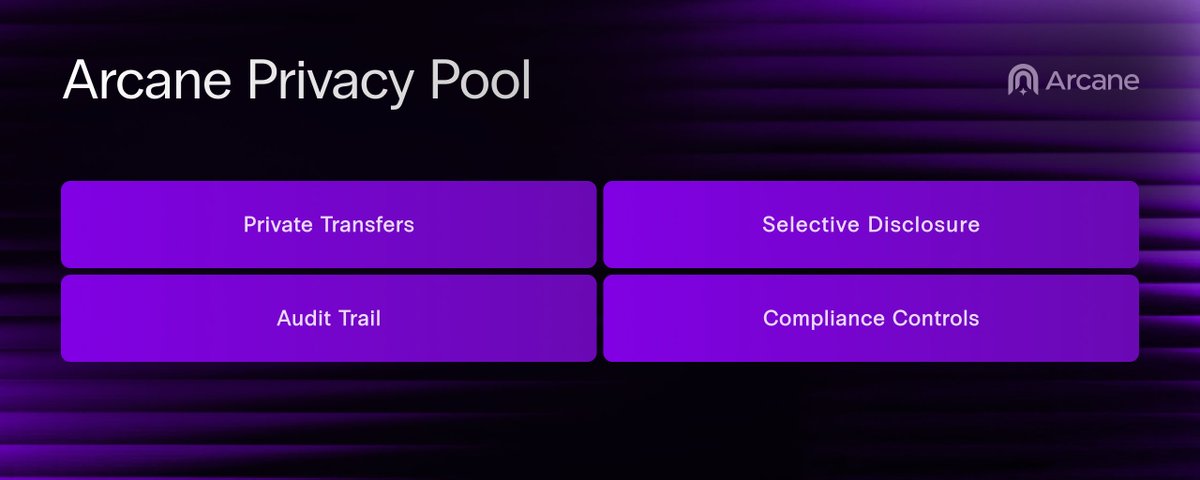
Arcane adds a shared privacy and compliance layer with built-in support for disclosure, auditability, and reporting on top of Stellar that enables applications to run private financial flows without building custom infrastructure from scratch. Applications can integrate the layer through Arcane’s SDKs and APIs, using a turnkey solution instead of developing bespoke privacy and reporting systems in-house.
At the core is a non-custodial compliance-ready ZK shielded pool where assets move privately between users and applications, combined with a structured audit layer that records encrypted transaction events. Each integrated application operates within its own logical domain while benefiting from a larger shared privacy set. Arcane also supports role-based disclosure, allowing users, operators, auditors, and regulators to access scoped information under defined conditions. Reporting is generated on demand and limited by role, time window, and data scope, and the product includes an interface for auditors to generate financial reports for regulators and investigate cases when required.
What Private Payroll and Institutional Payments Could Look Like
A practical way to think about the next phase of Stellar is through operational use cases. Private payroll is one clear example. A company paying staff on-chain may want the speed and settlement benefits of blockchain while still protecting salary amounts, wallet activity, and internal payment structure. With Arcane’s model, those flows can remain private by default while still supporting reporting for users, applications, auditors, or regulators when appropriate.
Institutional payments follow the same pattern. A network can have stablecoins, asset issuers, and payment providers, though broader institutional use depends on stronger confidentiality controls. Selective disclosure, compliance controls, outbound settlement rules, and integrations with compliance tooling create a more usable path for higher-value or higher-sensitivity payment activity.
That is why Stellar fits in the flow so well. The network has established payment relevance, stablecoin momentum, and institutional credibility. Arcane is building the privacy and compliance layer that can help those strengths support more real-world payment activity.
Keeping Illicit Funds Out of the System
For private payment infrastructure to support real-world financial activity, privacy has to sit alongside safeguards against illicit finance. Arcane’s compliance-ready privacy layer is designed to prevent illicit funds from entering and circulating within the shared private pool while preserving confidentiality for legitimate users.
That process starts before assets enter the system. Applications integrating Arcane can define pre-transaction compliance checks based on their use case and regulatory context, including KYT screening of incoming funds, wallet risk scoring, sanctions and watchlist screening, and jurisdiction-based restrictions such as IP or access controls. Arcane is also being built to support integrations with established compliance providers such as Elliptic, Chainalysis, Merkle Science, and Notabene. This gives applications a way to enforce their own compliance policies before funds are admitted into the private pool, helping maintain a clean and institution-ready environment rather than an open system for unchecked flows.
Monitoring, Disclosure, Investigations and Auditing
Compliance capabilities continue after funds enter the system. Arcane’s model supports ongoing transaction monitoring, risk re-evaluation as new intelligence becomes available, and selective disclosure for specific transactions or flows when required. This gives applications, auditors, and regulators a way to investigate suspicious activity, support reconciliation, and generate reporting without exposing unrelated transaction history.
The same structure applies to disclosure. Access can be limited by role, scope, and time window, allowing relevant parties to view only the information required for a compliance action or review. In practice, that means payment providers can verify source of funds, businesses can perform internal checks, and regulators can receive required reporting through a controlled process backed by a full audit trail. The result is a model built around clean entry, private execution, and controlled disclosure.
Building The Missing Layer
Stellar has the tools of a powerful payment network for payments, payroll, and institutional flows; privacy by default with controlled disclosure can help make that network more useful in practice. For a model like that to work at scale, private payment infrastructure also needs safeguards that help keep illicit funds out of the system, support transaction monitoring, and enable selective disclosure when compliance action is required.
Arcane’s focus is straightforward: bring compliance-ready privacy to Stellar in a form applications can actually integrate and use, with configurable controls that support cleaner entry into the pool, private execution by default, and reporting or investigation when needed.