From ZK Primitives to Production Financial Infrastructure

Stellar has become a serious network for payments, stablecoins, tokenized assets and financial applications. As more payroll flows, treasury operations and institutional transfers move on-chain, a sharper infrastructure question comes into view: what kind of privacy model can support real financial activity on public rails?
That question now has technical weight on Stellar. Recent protocol upgrades have made zero-knowledge applications more practical to build and teams such as Nethermind have already shown how private payment flows can be expressed on the network. Arcane Finance is building further along that path, with a focus on compliance-ready privacy for production financial infrastructure.
Why privacy now belongs in Stellar’s financial stack
Stellar already has the qualities that make this discussion worth having. The network was designed for financial products and payment flows and recent ecosystem activity has pushed that identity further into focus. PayPal brought PYUSD to Stellar for payments, remittances and PayFi use cases. Société Générale-FORGE selected Stellar for EUR CoinVertible, its MiCA-compliant euro stablecoin. Ondo Finance launched USDY on Stellar, Mercado Bitcoin announced a $200 million tokenized real-world asset issuance on the network and Archax and 21X each expanded work tied to tokenized financial infrastructure on Stellar.
These developments place Stellar in a category that matters for builders. It is a public network where stablecoins, tokenized assets and payment applications can operate in the same environment. Once that environment starts carrying meaningful financial activity, privacy becomes an infrastructure requirement. Payroll should not expose compensation history. Treasury flows should not reveal operating patterns. Consumer payments should not become a public behavioral record. Institutional settlement needs tighter data boundaries than a fully transparent transaction graph can offer.
What changed at the protocol layer
The case for privacy on Stellar now rests on technical progress as well as market relevance. Protocol 25, known as X-Ray, introduced native host functions for BN254 and Poseidon or Poseidon2, two primitives widely used in zero-knowledge systems.[5] BN254 supports pairing-based proof systems such as Groth16. Poseidon and Poseidon2 are hash functions designed to work efficiently inside zk circuits.
For builders, those additions reduce friction around the core objects used in private payment systems: commitments that hide note contents, nullifiers that prevent double-spends, Merkle roots that summarize pool state and proofs that show validity without exposing the transaction graph. Protocol 26 continues this direction with added host functions for BN254-related operations, including scalar-field arithmetic, multi-scalar multiplication and curve checks.[6]
Stellar did not become private by default through these upgrades. It became a more practical execution environment for teams building privacy-preserving applications in the same network where payment and asset activity already live.
From ZK primitives to application infrastructure
That is where Arcane fits. Arcane is building a non-custodial privacy layer for Stellar that gives applications a way to run private financial flows without building custom privacy, reporting and disclosure systems from scratch.
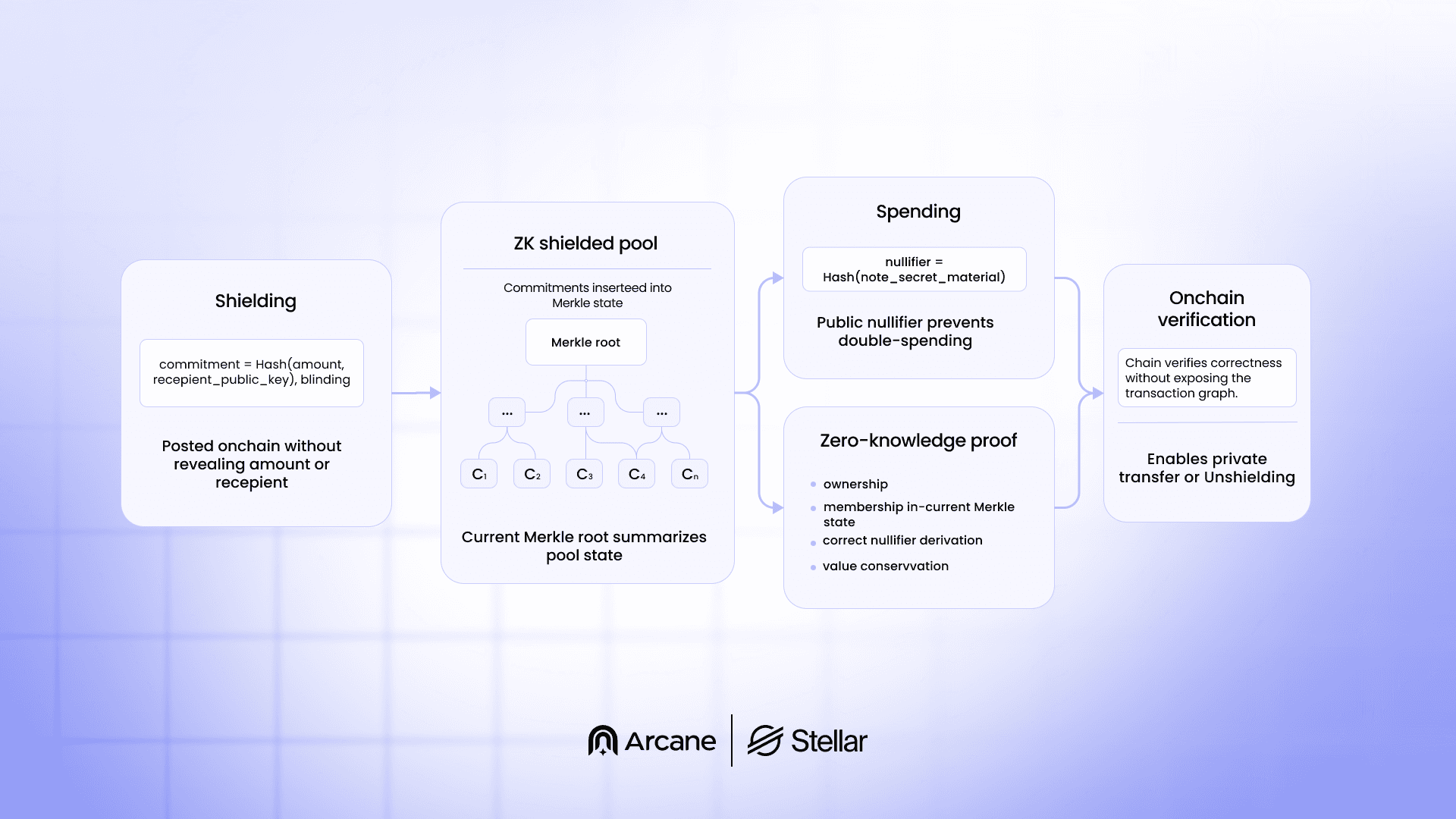
At the center is a ZK shielded pool. Users can shield assets into the private layer, transfer value privately and unshield when they need public settlement. The chain verifies correctness while keeping sensitive transaction details out of public view. In simplified form, a private note can be represented as:
commitment=Hash(amount,recipient_public_key,blinding)
That commitment can be posted on-chain and inserted into a Merkle tree without revealing the amount or recipient. When the note is spent, the system derives a nullifier:
nullifier=Hash(note_secret_material)
The nullifier is public and blocks double-spending. A zero-knowledge proof ties ownership, membership in the current Merkle state, correct nullifier derivation and value conservation into one verifiable transaction.
Arcane takes that cryptographic base and builds the application layer around it. That includes SDKs and APIs for integration, private address support for unlinkable receiving flows, encrypted audit events for reconciliation, role-based disclosure for operators and auditors, scoped reporting by case or time window and configurable compliance checks before assets enter the private pool.
The result is privacy designed for operational use by financial applications rather than a circuit demo attached to a wallet. This core pattern already appears in Nethermind’s Stellar prototype.
Private addresses, reference implementations and production reality
Some of Arcane’s internal privacy design also relies on BabyJubJub, an elliptic curve often used inside zk circuits because it fits naturally into the Circom and BN254 ecosystem. This supports private receiving flows, where a user can receive private notes without making every incoming transaction linkable to one public identity. Stellar did not add BabyJubJub as a native primitive. Arcane uses it at the application and circuit level while relying on Stellar’s broader BN254 support to make the proof environment more practical.[5]
A separate ecosystem reference comes from Nethermind’s Privacy Engineering team. Its stellar-private-payments project demonstrated a proof-of-concept private payments system on Stellar using Soroban smart contracts, Circom circuits, Groth16 proofs, Poseidon2 hashing, Merkle trees, commitments and nullifiers.[7] Nethermind presented the work as a research prototype and stated that it was not audited or intended for production assets. The project is useful as a technical reference for private deposits, transfers and withdrawals on Stellar through a familiar zk architecture. This reference is distinct from Arcane’s BabyJubJub-based design.
Arcane builds on that architectural path with a stronger production focus. For professional on-chain builders, that distinction matters. Production privacy depends on more than valid proofs. It depends on key management, wallet and application UX, encrypted event storage, monitoring, disclosure governance, reporting flows and clean integration patterns for teams shipping financial products.
Compliance-ready privacy for real financial workflows
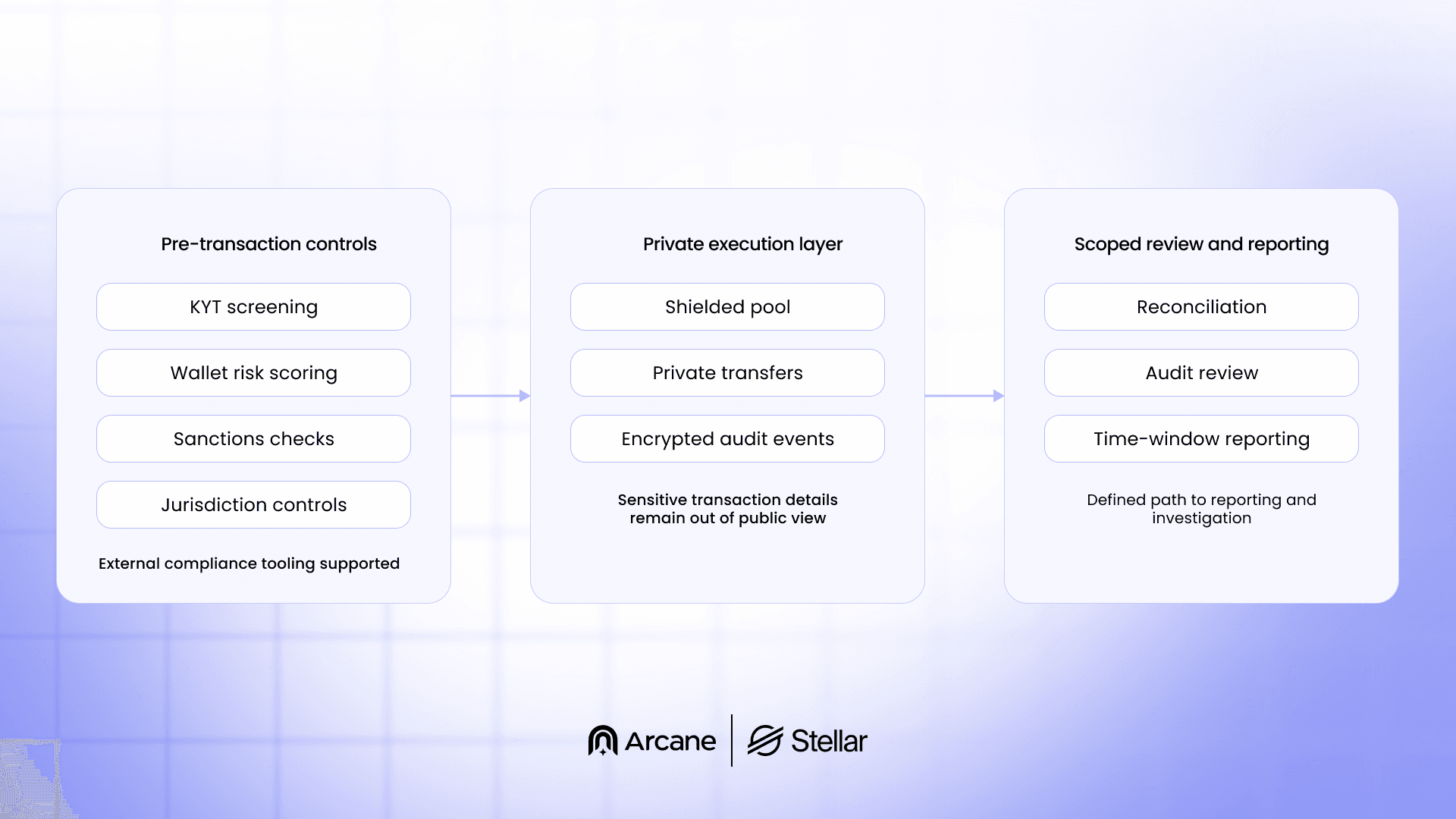
The strongest privacy system for finance still has to answer operational questions. Applications need controls around illicit finance risk, audits and investigations. Arcane approaches this with a model built around clean entry into the pool, private execution inside it and scoped disclosure when review is required.
Before assets enter the private layer, integrated applications can define pre-transaction checks based on their use case and regulatory context. Those checks can include KYT screening, wallet risk scoring, sanctions checks and jurisdiction controls, with support for external compliance tooling where needed. Once assets are inside the system, transaction details remain private by default. Encrypted audit events support reconciliation and later review without exposing unrelated users or unrelated payment history.
That structure makes the product legible for real use cases. A company running payroll on-chain may want faster settlement and easier reconciliation without turning salary data into public transaction history. A fintech moving treasury funds may need confidentiality around balances and payment patterns. A stablecoin or asset platform may need stronger privacy controls before larger or more sensitive flows can move on public rails. In each case, the requirement is similar: protect sensitive financial activity while preserving a defined path to reporting and investigation.
Conclusion
Stellar now combines financial relevance with a more practical foundation for zero-knowledge applications and the recent zk upgrades made privacy-preserving systems more practical, Nethermind’s prototype made the architecture tangible and Arcane is building the production layer financial applications need.
For builders working on payroll, treasury, stablecoin payments, tokenized assets and institutional settlement on Stellar, the problem is clear and the opportunity is real. Private execution, scoped disclosure and application-level compliance controls belong in the same stack.
Sources
[1] Stellar Development Foundation, PYUSD on Stellar announcement: https://stellar.org
[2] Société Générale-FORGE, EUR CoinVertible on Stellar announcement: https://www.sgforge.com
[3] Ondo Finance, USDY on Stellar announcement: https://ondo.finance
[4] Mercado Bitcoin, Archax, 21X and Stellar ecosystem announcements: https://stellar.org
[5] Stellar Developers documentation, Protocol 25 / X-Ray and zk-related host functions: https://developers.stellar.org
[6] Stellar Core / protocol upgrade materials for Protocol 26: https://developers.stellar.org
[7] Nethermind Privacy Engineering, stellar-private-payments repository: https://github.com/NethermindEth/stellar-private-payments