Arcane × Predicate. Building the Compliance Stack for Private Applications on Stellar

Private financial applications are moving closer to production. Confidential assets, private payments, and zero-knowledge systems are becoming practical infrastructure rather than research projects. As that happens, the focus shifts from whether privacy is technically possible to how these systems can operate in regulated environments.
For banks, fintech companies, and asset issuers, privacy does not change the underlying compliance responsibilities. Organizations still need to control who can participate, monitor financial activity, respond when risk changes, and provide evidence when an authorized investigation requires it. What changes is access to the data behind those workflows: in a confidential system, transaction information is no longer public by default.
Arcane and Predicate are addressing this problem together on Stellar. We are combining Predicate’s programmable compliance platform with Arcane’s privacy operations infrastructure to create a unified compliance stack for private applications and confidential assets.
A complete workflow for private finance
The combined solution is designed to fully cover the compliance lifecycle of a private financial application.
Before funds enter a confidential environment, participants and funding addresses can be evaluated against identity, AML, KYT, sanctions, and application-specific policies. Once admitted, users can transact privately while the information required for authorized future review remains protected.
Compliance continues after execution. Risk profiles change, sanctions lists are updated, new blockchain intelligence becomes available, and an organization may receive an external request or initiate its own investigation. When those events require a compliance action, the application can apply the appropriate restriction. When they require access to confidential transaction evidence, the compliance team can open a governed investigation and disclose only the information relevant to the case.
Consider a participant who passes the required checks and enters a private application. Several weeks later, new intelligence changes the risk profile of the funding address. The organization’s policy may require a restriction while its compliance team investigates the historical activity associated with that participant. The relevant confidential evidence can then be reviewed through an approved, scoped disclosure process, with the resulting access retained in the audit history.
Arcane and Predicate connect these stages into one operating model. Predicate provides the controls used to determine and enforce the appropriate compliance action. Arcane provides the protected path into confidential transaction data when that action requires investigation or disclosure.
The result is a compliance workflow that can continue before, during, and after private execution.
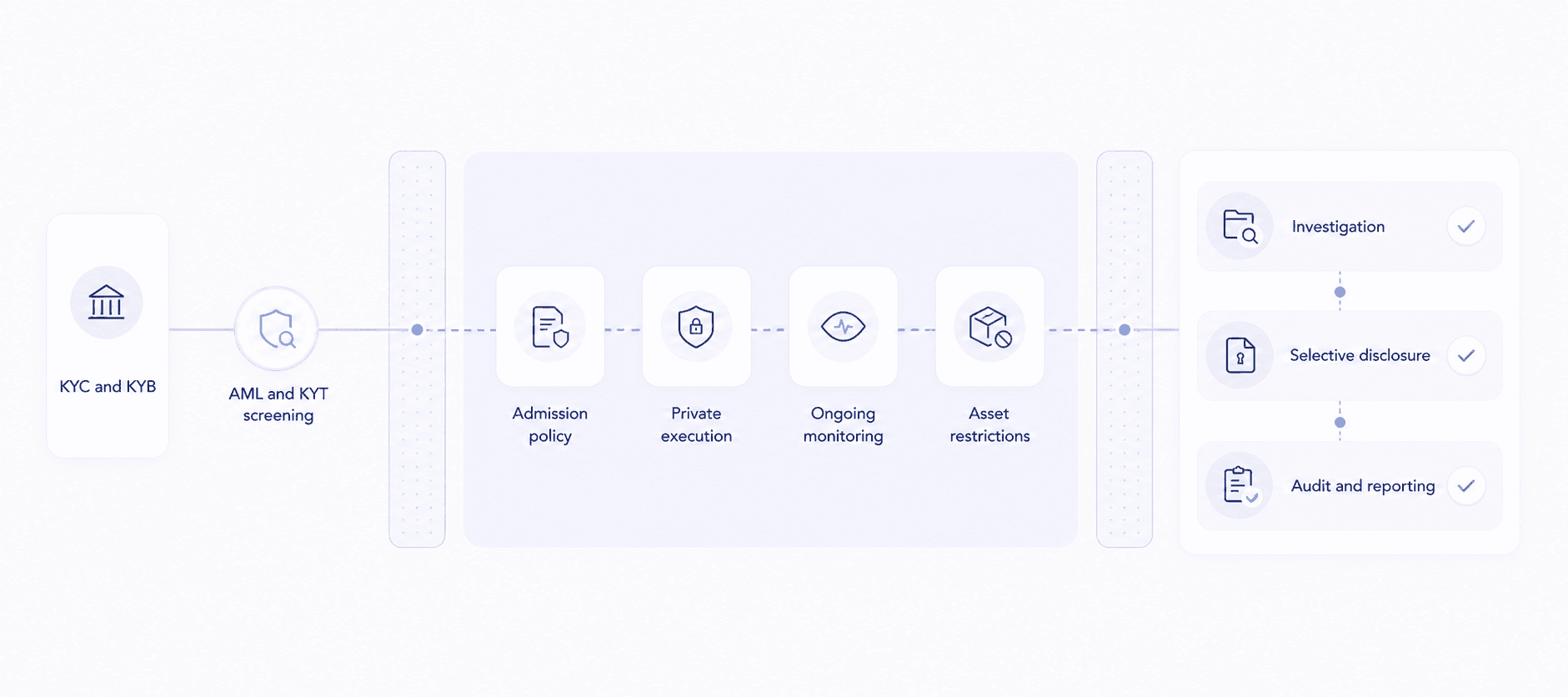
Predicate turns compliance policy into on-chain controls
Predicate has built its platform around a practical problem for regulated digital assets: compliance requirements need to result in actions that an application or asset can actually enforce.
Its infrastructure supports KYC and KYB workflows, AML and KYT screening, sanctions policies, ongoing monitoring, and real-time asset-level controls. For blockchain analytics and transaction risk signals, Predicate works with underlying blockchain analytics and data providers. Organizations can define policies governing access to an application or asset and connect those policies directly to the underlying transaction flow.
This makes Predicate materially different from a conventional source of wallet risk data. A risk signal by itself does not tell an application what to do. Predicate connects that signal to policy and real-time on-chain enforcement.
At onboarding, Predicate can evaluate identity requirements, blockchain risk, sanctions exposure, jurisdiction-specific rules, and application-specific policies in sub-second latency. The resulting decision determines whether a participant is allowed to proceed and which controls apply.
That policy remains relevant after onboarding. An address that is acceptable today may later become associated with sanctioned activity, an exploit, or another risk condition. Predicate can evaluate new signals against the organization’s current policy and determine the appropriate response.
Predicate Asset Compliance extends this model to the asset itself. Where an asset exposes a freeze-manager or equivalent control role, Predicate can connect directly to that role and support automated or manual restrictions, including address freezes, temporary pauses, transfer restrictions, or notifications for additional review.
Predicate already applies this operating model across regulated digital assets, including workflows for deposit screening, permissioning, automated and manual freezes, and asset-level controls. For private finance, this means the enforcement layer does not need to be redesigned simply because the underlying application becomes confidential.
Arcane extends the workflow into confidential environments
The second part of the problem appears once the evidence itself becomes private.
On a public blockchain, a compliance team can restrict an address and still inspect the transaction history associated with it. In a private application, balances, amounts, counterparties, or other transaction data may be encrypted. The organization still needs to investigate suspicious activity and support authorized reviews, but the relevant evidence cannot simply be retrieved from a block explorer.
Arcane provides the privacy operations infrastructure for this environment.
Private transactions can produce encrypted audit events alongside their onchain execution. Arcane indexes those events while keeping the underlying evidence protected, and the viewing or auditor keys required to access confidential information are managed separately from the employees and applications that may eventually use them.
When review is required, access happens through an investigation rather than through a permanent administrative view into private activity.
A compliance officer can create a case and define the relevant application, transaction scope, data to be disclosed, reviewers, and access period. The request follows the organization’s approval policy before confidential information becomes available, and the resulting access and disclosure events remain part of the audit history.
This allows an institution to investigate a specific case without weakening privacy across the rest of the application. An auditor can receive the evidence required for a review, while unrelated users and transactions remain confidential.
The two platforms therefore operate at complementary parts of the same workflow. Predicate governs the compliance controls applied to financial activity. Arcane governs access to the confidential evidence required when those controls lead to investigation or disclosure.
From lawful orders to governed disclosure
Lawful requests are one example where both parts of the architecture become important.
A request from law enforcement or another authorized body may require an organization to restrict an address, investigate historical activity, or provide specific transaction evidence. The organization first needs to establish that the request is authentic, legally valid, and appropriately scoped.
Predicate has operational capabilities around this process. Its compliance workflows can support the review of a lawful request and the resulting asset-level action. Where a valid request requires a restriction, the same control infrastructure used for ongoing enforcement can be used to apply a manual freeze or another appropriate action.
In a confidential application, fulfilling that request may also require access to protected transaction information.
Arcane extends the process into the privacy layer. Once the request and scope have been established, authorized reviewers can open an investigation, identify the required encrypted records, route access through the organization’s approval workflow, and disclose only the evidence required for the case.
This creates a direct path from regulatory action to governed disclosure without turning confidential transaction history into an unrestricted administrative dataset. The control and compliance operational support is applied through Predicate, while the associated evidence remains protected and accessible through Arcane’s investigation workflow.

A clearer path to private applications on Stellar
Stellar already supports a broad ecosystem of payments, stablecoins, asset issuance, and financial applications. As privacy infrastructure expands what can move onchain without exposing sensitive financial information publicly, builders also need an operating model for taking those applications into regulated production environments.
Arcane and Predicate are bringing that model together on Stellar.
The initial integration combines Predicate transaction screening with Arcane’s privacy-specific investigation and disclosure infrastructure. The next extension brings Predicate Asset Compliance into the same lifecycle, connecting changes in risk and policy to asset-level controls within private applications.
For a team building on Stellar, this means the compliance architecture can exist as shared infrastructure rather than being rebuilt around each new private product. The underlying privacy technology may differ between ZK applications, confidential assets, and other approaches, while the operational requirements remain largely consistent: admit participants, apply policy over time, respond when risk changes, investigate exceptions, and disclose evidence through a governed process.
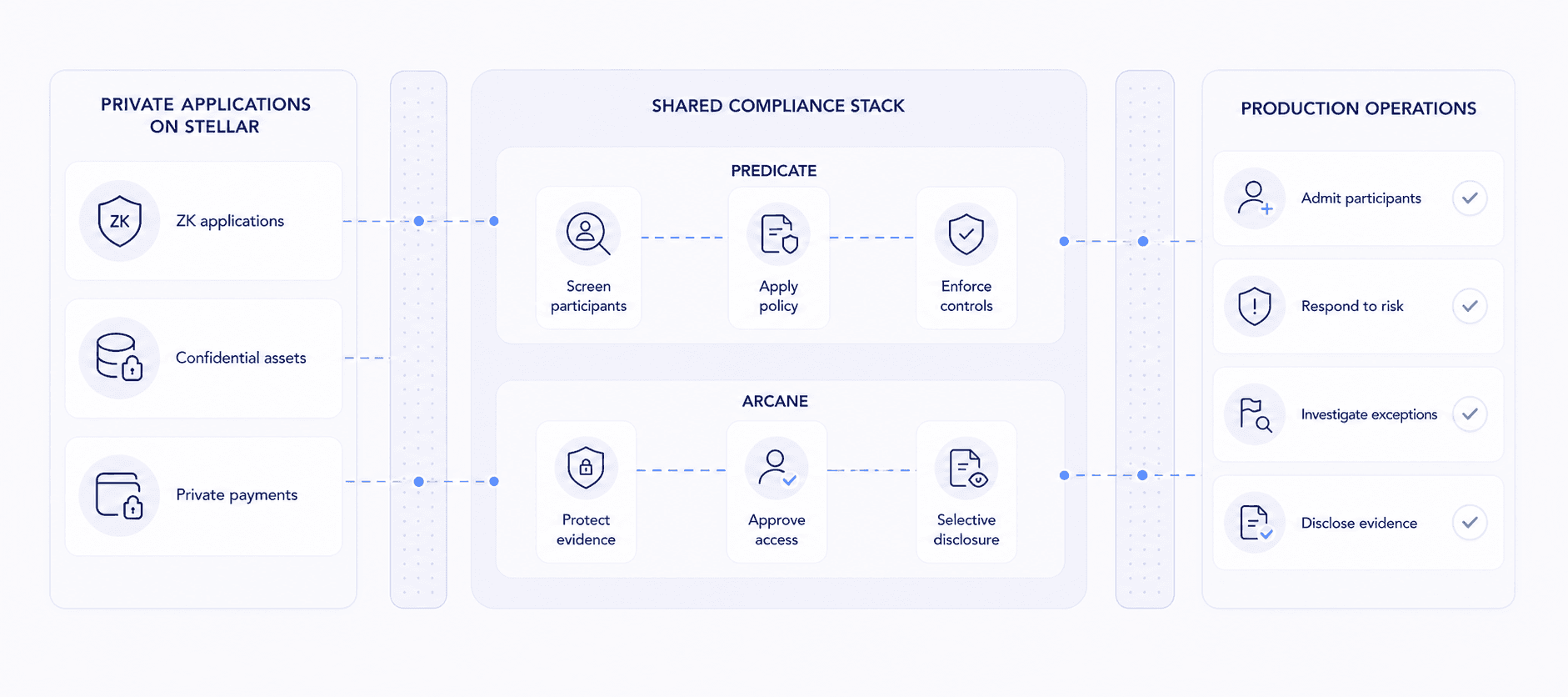
That creates a more direct path from confidential execution to a production financial application. It also gives banks, issuers, and fintech companies a clearer separation between compliance enforcement and access to private transaction evidence.
Building the stack together
Arcane and Predicate are continuing to deepen the integration on Stellar across transaction screening, asset compliance, investigations, and selective disclosure.
Predicate brings an established control platform for translating compliance requirements into actions that can be enforced in onchain financial products. Arcane provides the infrastructure required when those products become confidential and the underlying evidence must remain protected by default.
Together, we are building a compliance stack that allows private applications on Stellar to combine programmable enforcement with governed access to confidential information, giving regulated financial institutions a more practical path to using privacy in production.